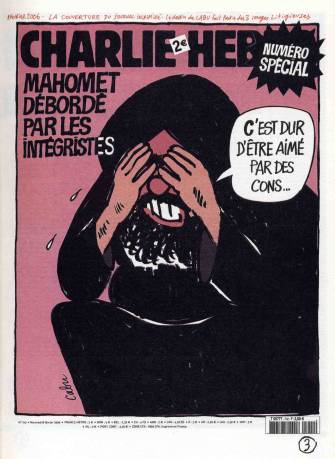
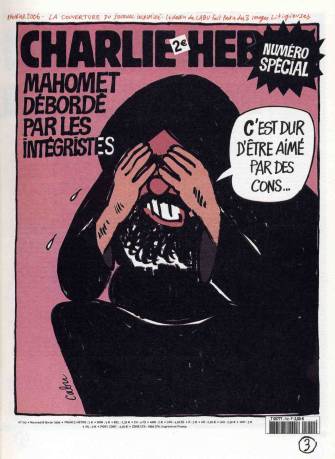
The latest Charlie Hebdo cover
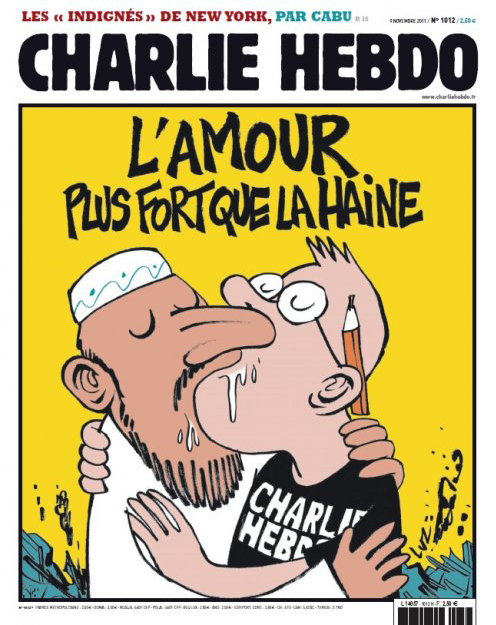
Hats off to Charlie Hebdo. This is tomorrow’s cover:
Housed in its temporary offices at Liberation, Charlie Hebdo looks set to publish on schedule tomorrow, uninterrupted by last week’s devastating firebomb.
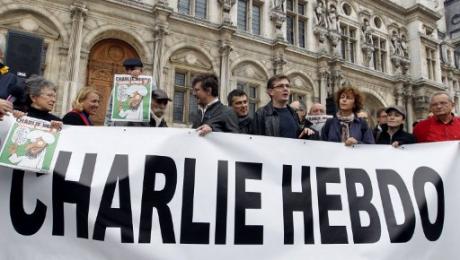
Hundreds of people demonstrated in support of the satirical weekly on Sunday.
The president of SOS Racism was among the supporters, declaring that
In a democracy, the right to blaspheme is absolute.
Editor “Charb” said,
We need a level playing field. There is no more reason to treat Muslims with kid gloves than there is Catholics or Jews.
Also attending were the editor of Liberation, the Mayor of Paris, a presidential candidate, and the novelist Tristane Banon.
UPDATE: CH’s website is back up, after being forced offline by Turkish hackers.
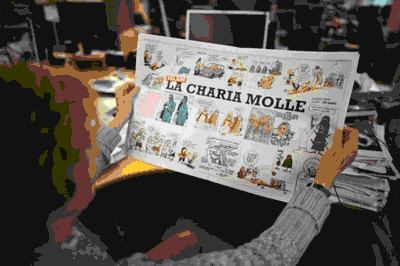
The French satirical paper has reacted defiantly to the firebombing of its offices by teaming up with Liberation to produce a special supplement which reproduces the controversial images. The 4-page wraparound was distributed with Thursday’s edition of the daily newspaper.
We thought the lines had moved and that maybe there would be more respect for our satirical work, our right to mock. Freedom to have a good laugh is as important as freedom of speech.
Liberation‘s editor, Nicolas Demorand, said his paper’s offices were opened to Charlie Hebdo staff as “a basic gesture of solidarity”.
They will also print an extra 175,000 copies of Wednesday’s edition of Charlie Hebdo, as the initial print run of 75,000 sold out quickly.
Nice work, firebombers.
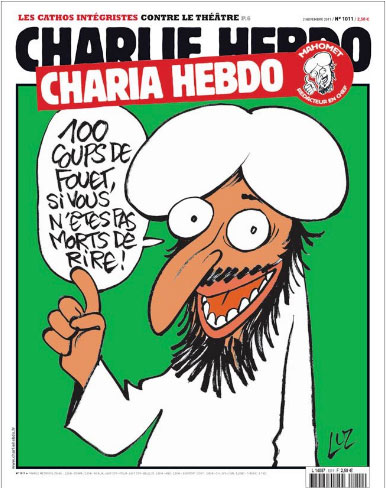
The offices of French satirical magazine Charlie Hebdo has been firebombed, causing extensive damage, because the latest edition, entitled Charia Hebdo, carried a cartoon of Mohammed on the cover.
A single petrol bomb was thrown through the window at approximately 3am. There were no injuries.
This is not the first time Charlie Hebdo has been on the receiving end of Muslim rage. MWW covered extensively the protests, and the trial and acquittal of its editor Philippe Val which followed the publication of this special edition:
Reporters Without Borders reports that a Paris appeal court has once again acquitted Philippe Val, editor of Charlie Hebdo, on charges of insulting Muslims.
The appeal against the original verdict was brought be the Union of Islamic Organisations of France. Perhaps now they will let it go.

(Hat tip for this and the Motoons update below, to the Comics Reporter)

Philippe Val, the editor of the French satirical weekly Charlie Hebdo who was acquitted last year of charges of “offending Muslims”, was back is court yesterday on the same charges.
The Paris Grand Mosque accepted the March 07 ruling, but it was appealed by the Union of Islamic Organisations of France and later by the Saudi-based World Muslim League. At the start of yesterday’s hearing the court ruled that the WML was not an admissible plaintiff, so the UOIF was left to fight alone.
The verdict is expected next month.
This is Charlie Hebdo’s third appearance in a French court since it first published the Motoons (and other prophet-based funnies) in Feb 2006.
French comic artist Joann Sfar has released an illustrated account of the Charlie Hebdo trial.
Sfar sat through the entire procedure, recording the testimonies of all the witnesses. The unique result is a graphic record entitled Greffier which was published at the end of March.
(Hat tip, The Comics Reporter)
A press release by the Grande Mosque de Paris indicates that questions about the clarity of the Charlie Hebdo verdict are justified.
Dalil Boubakeur, president of the French Council of Muslims, states that the verdict largely justified the action against the publication of the cartoons, which he somewhat hysterically describes as a “deliberate act of racist violence”, and concludes:
The judgement pronounced by the Tribunal de Grande Instance de Paris serves as an official warning against such acts of aggression in the future
Contrary to previous reports, he does not rule out the possibility of an appeal with with the Union of Islamic Organisations. Though why an appeal would be necessary, considering the verdict was such a great victory, he does not say.
Nearly a year and a half since the Jyllands-Posten published its infamous 12 Motoons, and over a year since worldwide tantrums were thrown as a result, a Danish paper felt confident enough that the climate had changed, and printed an article about the gently-blasphemous webcomic Jesus and Mo.
According to the cartoonist’s blog, the main thrust of the article in Information was the Charlie Hebdo trial, and the Jesus and Mo cartoons were printed as a direct challenge to Carsten Juste, editor of the rival daily Jyllands-Posten. This from the Information blog:
Thus, Jyllands-Postens editor-in-chief was wrong when he predicted that nobody would draw the prophet Muhammed after the Muhammed-crisis, to which he pathetically added “therefore I am deeply ashamed to say: They have won!”.
These cartoons might be of another nature, the context might be different, or perhaps the entire over-excited conflict has settled down to a more peaceful level, so that few people will take offense from these cartoons in the papers.
The journalist who wrote the story, Niels Ivar Larsen, there has been absolutely no uproar.
Here is one of the cartoons that appeared in Information last week:

(Hat tip Harry’s Place)
Oliver Kamm has a question about yesterday’s Charlie Hebdo acquittal which is worth examining:
Note, however, one aspect of the judgement, according to the BBC report, that troubles me: ‘The cartoons were covered by freedom of expression laws and were not an attack on Islam, but fundamentalists, it said.’ Do freedom of expression laws not cover an attack on Islam? It is essential that they should. There is nothing wrong with an attack on Islam (or any other sacred belief). There is nothing wrong with giving offence to religious groups. The judgement appears implicitly to reject these principles. Defenders of a free society must assert them militantly.
Quite so. It is a pity that the judge did not make that more clear.
David Thompson takes the point further:
Religious freedom is presumed to entail sparing believers any hint that others do not share their beliefs, and indeed may find them ludicrous. There is, apparently, no corresponding obligation for believers to embrace ideas that are not clearly risible, monstrous or disgusting. When given a moment’s thought, this protectionist claim is decidedly fascistic in its practical implications. If believers wish to be insulated from any differing opinion, and even statements of fact, they would have to create a closed religious order, somewhere atop a mountain where reality can to some extent be avoided.
Having said all that, there is still cause to celebrate the fact that the French court delivered a very important, and in most aspects correct, verdict.